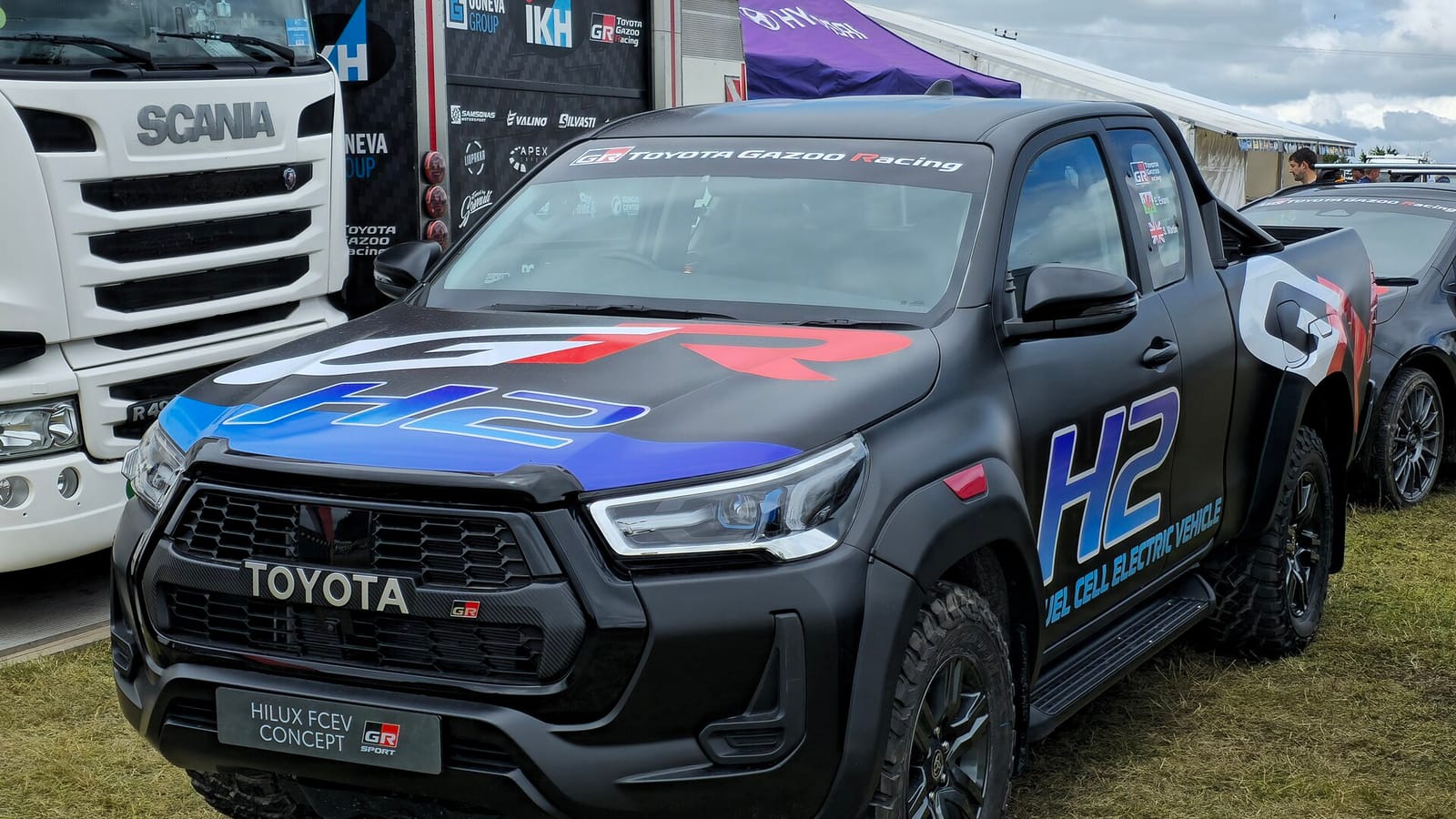
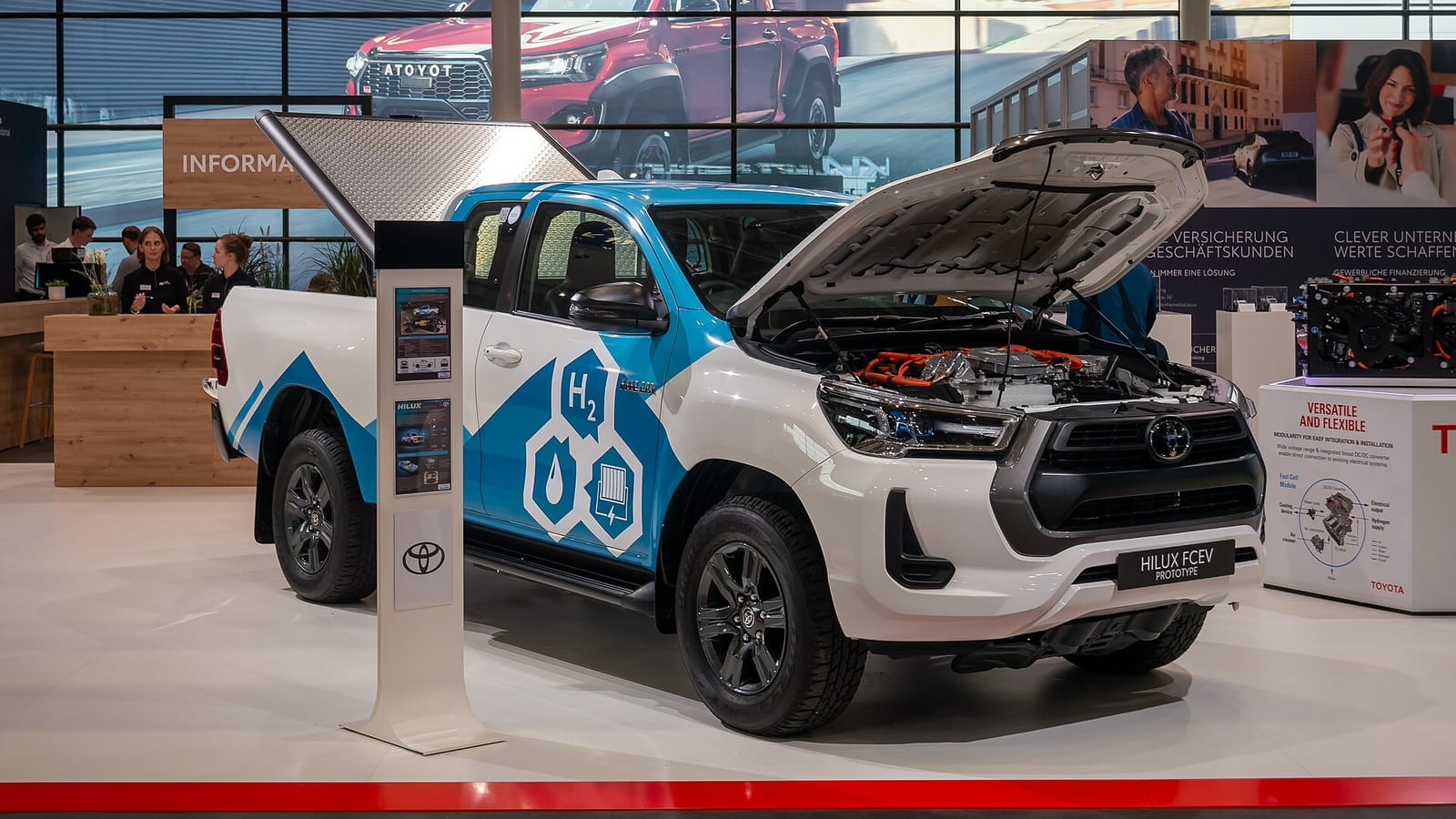
On 16 September 2026 Toyota showed the first picture of a hydrogen Hilux it plans to sell, and gave it a date: 2028. It was announced at a truck show in Hannover, Germany. It will be sold to European fleets first. It will join the diesel, the mild hybrid and the electric Hilux in Toyota’s range.
If you are South African, two questions matter more than the specs. Did this bakkie have anything to do with us? And will you ever be able to buy one here and fill it up? The answer to the first is yes, more than most people know. The answer to the second is not yet. This guide is honest about why.
What Toyota actually confirmed
Strip away the launch talk and these are the facts:
| Hilux FCEV (production target) | |
|---|---|
| Powertrain | Hydrogen fuel cell derived from the Toyota Mirai, driving an electric motor |
| Range | More than 400 km (WLTP) |
| Braked towing | 2,500 kg |
| Refuel time | About five minutes |
| First market | Europe, 2028, corporate fleets and leasing first |
| Emissions | Water vapour only at the tailpipe |
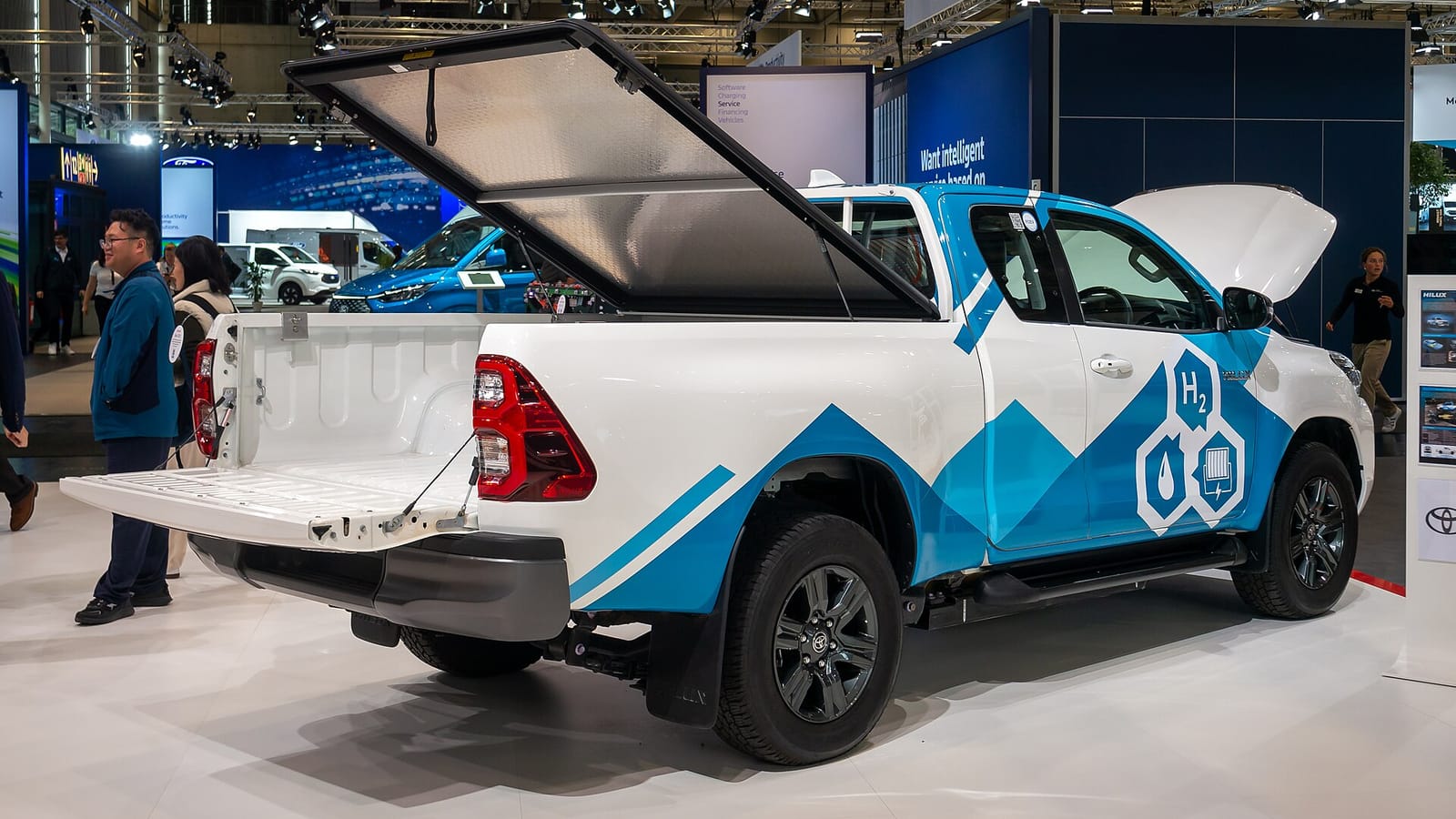
Toyota has not said how much power the production version will have. The 2024 test bakkies had a 128 kW fuel cell and a 134 kW electric motor on the back axle. Three tanks inside the chassis held 7.8 kg of hydrogen. Toyota claimed up to 600 km from those. The production target is “more than 400 km”, which is more cautious, and cautious numbers are usually the ones that turn out to be true.
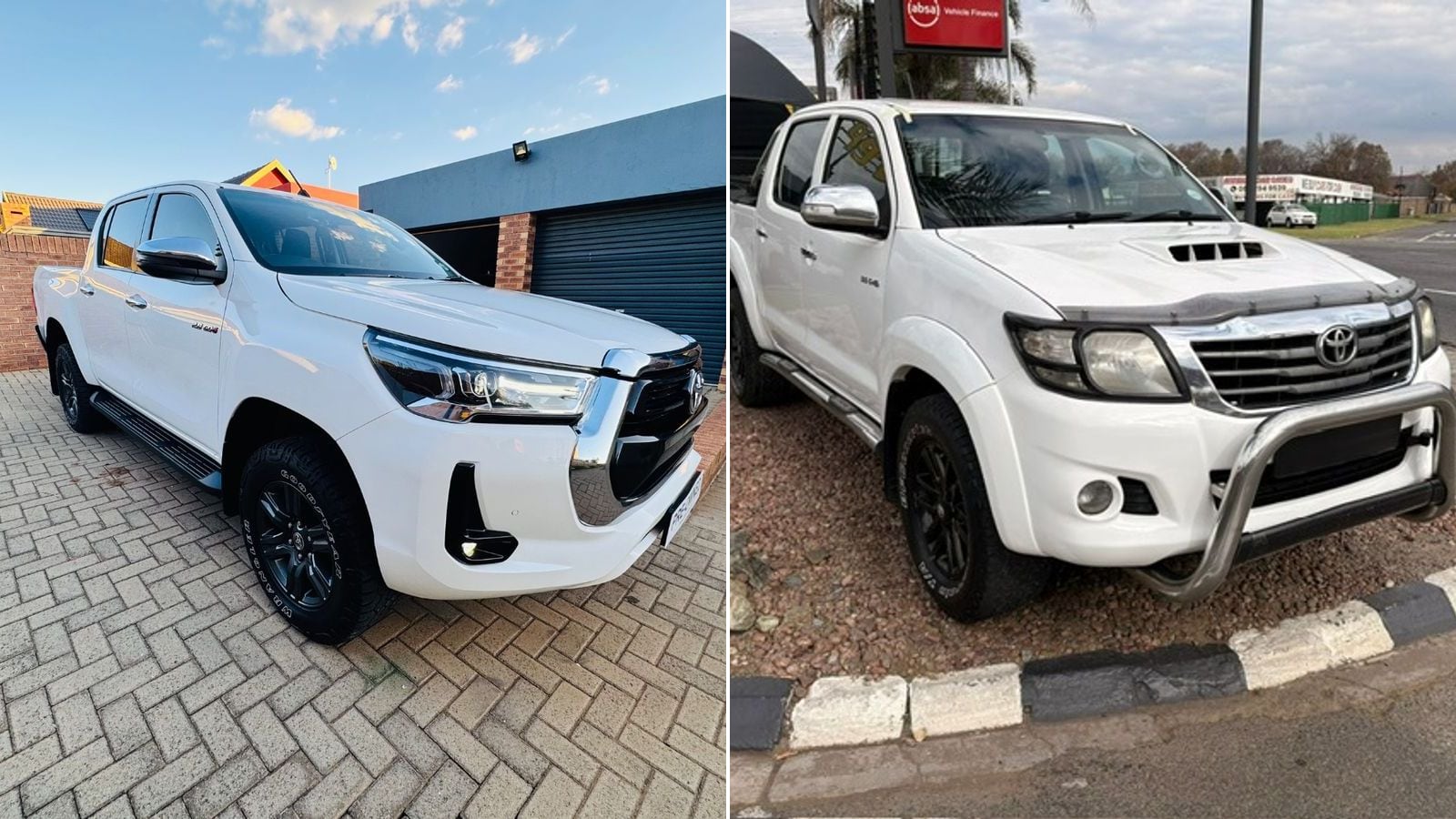
The teaser photo shows a new headlight design that no current Hilux has. That suggests the hydrogen bakkie will use the new-shape Hilux body, not the older one the test bakkies used.
The Durban connection
The ten hydrogen test bakkies were put together at Toyota’s factory in Derbyshire, England, in 2023. British engineering firms and British government money did the work. What the British reports leave out is where the bakkies came from.
They came from Durban. Toyota South Africa’s boss, Andrew Kirby, said in October 2023 that the base vehicles were built at the Prospecton plant, the same factory that builds every Hilux sold here. In his words, South Africa “supported them with the base vehicle” and “sent some people across to help with the conversion.” The hydrogen parts were fitted in England. The bakkie underneath was ours.
That matters for 2028. Prospecton already builds the Hiluxes that go to Europe, and Europe is where the hydrogen Hilux will be sold first. With the test bakkies, Toyota built a normal Hilux in Durban and fitted the hydrogen system in Europe. If it does the same again, these bakkies could start their lives here. Toyota has not said that. But the pipeline exists.
Where would you fill it up?
This is the question that decides whether the hydrogen Hilux is a South African story or a European one. The honest answer, in September 2026, is that there is no public hydrogen filling station in South Africa. Not one that a private owner could drive to.
What does exist:
- A plan for the N3. In April 2021 Sasol and Toyota said they would build hydrogen filling points along the N3 between Johannesburg and Durban. The plan is for trucks, not cars. Air Products joined later.
- A demonstration station. In October 2023 the three partners showed a working hydrogen pump and a Toyota Mirai at a mobility show in Gauteng. The hydrogen came from Sasol’s small solar plant at Sasolburg, which was making about 150 kg a day at the time.
- The Hydrogen Valley. A plan by government, Anglo American Platinum and Engie to build a hydrogen industry from Mokopane in Limpopo, through Gauteng, down to Durban. The most visible piece so far is a hydrogen mine truck at Anglo’s Mogalakwena mine.
- A tax break. From 2026, companies get a 150 percent tax deduction on money they invest in building electric and hydrogen vehicles. That helps factories, not buyers.
What Kirby said in 2023 still holds. He asked how long it would take to make the bakkie available commercially, and whether the filling stations would be there for the customer. The bakkie is the easy part. Toyota builds hydrogen cars by the thousand already. What South Africa does not have is anyone committed to building filling stations for ordinary drivers. The current plan is trucks, on one highway.
The platinum argument
There is a reason South Africa keeps coming up in hydrogen announcements. It is under the ground in Limpopo and the North West. A fuel cell needs platinum to work, and South Africa mines most of the world’s platinum. The big mining houses, Anglo American Platinum, Sibanye-Stillwater and Impala, all make more money if fuel-cell vehicles take off. That is why the mines, not the car companies, have paid for the local demonstrations.
That gives the hydrogen Hilux friends in South Africa that the electric Hilux does not have. It does not build a filling station. But if any African country gets a hydrogen bakkie, it will probably be this one.
What it would cost to run
Only one local number has ever been put on record, by Kirby in 2023. If hydrogen cost less than two dollars a kilogram, about R40 at the time, a hydrogen Hilux would do 100 km for about R40. The diesel Hilux does 100 km for about R180.
Treat that with care. Nobody sells green hydrogen at a pump in South Africa, so there is no real price. In Europe, hydrogen at the pump costs several times that two-dollar figure. The test bakkie’s 7.8 kg tank does 400 to 600 km, so it uses roughly 1.3 to 2 kg per 100 km. What that costs depends entirely on a pump price that does not exist here yet.
Hydrogen against diesel and battery, for a bakkie
The table below is the reason Toyota is bothering with hydrogen in a bakkie at all. An electric Hilux exists. It is fine for delivery rounds in town. It is not a bakkie in the South African sense.
| Hilux 2.8 GD-6 diesel | Hilux BEV | Hilux FCEV (target) | |
|---|---|---|---|
| Range | Over 1,000 km claimed (80 L tank) | About 240 km (WLTP) | Over 400 km (WLTP) |
| Braked towing | 3,500 kg | 1,600 kg | 2,500 kg |
| Refuel or recharge | Five minutes, anywhere | Hours on AC, under an hour on DC fast charge | About five minutes, where there is a station |
| Sold in SA | Yes, from R658,500 | Listed, small sample only | Not confirmed |
The fuel cell gets a bakkie most of the way back to diesel on range and towing, and all the way back on filling time. That is why Toyota is aiming it at working fleets, and why it went into the Hilux and not a hatchback. The catch is the filling station. A diesel fills up at every garage in the country. The hydrogen Hilux fills up at 179 stations in the whole of Europe. Toyota’s own press material names that as the main obstacle.
What a South African Hilux buyer can actually get today
The hydrogen Hilux is a 2028 launch, in Europe. The new-shape Hilux has been on sale here since June 2026. It is worth being clear about what is and is not in the showroom.
| Derivative | Price |
|---|---|
| Xtra Cab 2.8 GD-6 Raider X 6AT 4x2 | R751,800 |
| Xtra Cab 2.8 GD-6 Raider X 6AT 4x4 | R842,200 |
| Double Cab 2.8 GD-6 SRX 6AT 4x2 | R658,500 |
| Double Cab 2.8 GD-6 SRX 6AT 4x4 | R746,100 |
| Double Cab 2.8 GD-6 Raider 6AT 4x4 | R892,900 |
| Double Cab 2.8 GD-6 Legend MHEV 6AT 4x2 | R945,500 |
| Double Cab 2.8 GD-6 Legend MHEV 6AT 4x4 | R999,900 |
Every one of these has the same 2.8 diesel as before, with 150 kW and 500 Nm and a six-speed automatic. All come with a three-year or 100,000 km warranty and a nine-service or 90,000 km service plan. The Legend adds a small 48-volt hybrid system. It makes stop-start smoother and helps the bakkie pull away. It does not save much fuel: CAR Magazine got 10.1 litres per 100 km against Toyota’s claim of 7.5. Do not buy it for the economy.
The electric Hilux is on Toyota South Africa’s website, but you cannot really buy one. In June 2026 Toyota SA’s Riaan Esterhuysen called it “still in its infancy”. He said a small number are being brought in “just to check local market response”. Toyota did the same thing with the RAV4 plug-in hybrid: a few test units in 2022, then a proper launch in 2024. If the hydrogen Hilux ever comes here, expect the same. A handful of bakkies with a fleet partner, years before there is a price list.
What this does to the used Hilux market
Nothing, for now. And that is the useful part. There are about 4,900 GD-6 Hiluxes for sale on BakkiesSA right now, asking around R504,000 in the middle of the range, with the 2.8 at about R646,000. The hydrogen announcement changes none of that. The diesel Hilux will be the bakkie South Africa buys for the rest of this decade, and the 2.8 is the engine that holds its value. The Hilux market page tracks that every day.
Where it might matter is further out. Hydrogen and electric bakkies may be a real part of the market here one day, or they may not. Either way, a Hilux bought new today will be six or seven years old by then. By then, as the resale guide shows, a Hilux has already done most of its losing value. So buy the diesel, keep the service book, and let Toyota and Sasol argue about the filling stations.
Questions people ask
When is the hydrogen Toyota Hilux coming out?
Toyota confirmed in September 2026 that a production Hilux FCEV will go on sale in 2028. The first market is Europe, and the first customers are corporate fleets and leasing companies rather than private buyers. Toyota South Africa has not confirmed it for our market, and CAR Magazine reported on 18 September 2026 that both the hydrogen and battery-electric Hilux remain unconfirmed for South Africa.
Will the hydrogen Hilux be sold in South Africa?
Not confirmed. Toyota South Africa's CEO Andrew Kirby has said the local case depends on whether Sasol, Air Products and others build the hydrogen supply and filling infrastructure, and there is still no public hydrogen filling station in the country. The base vehicles for the ten UK prototypes were built at Toyota's Prospecton plant in Durban, so the manufacturing link is already there.
How far can the hydrogen Hilux go on a tank?
Toyota's target for the production version is more than 400 km on the WLTP cycle, with a braked towing capacity of 2,500 kg and a refill of around five minutes. The 2023 prototypes carried 7.8 kg of hydrogen in three tanks and were claimed to be capable of up to 600 km. A standard 2.8 GD-6 diesel Hilux does over 1,000 km on its 80-litre tank and tows 3,500 kg.
What does the new Hilux cost in South Africa?
The ninth-generation Hilux went on sale in South Africa in June 2026 at R658,500 for the Double Cab 2.8 GD-6 SRX 4x2, rising to R999,900 for the Legend 48V mild-hybrid 4x4. Every launch model uses the 150 kW, 500 Nm 2.8 GD-6 diesel with a six-speed automatic. The electric Hilux BEV is listed on Toyota SA's website but is being brought in as a small sample to gauge demand, not as a full commercial launch.
Figures are seller asking prices aggregated from South African listing platforms and dealers, not final selling prices. Most vehicles transact below asking. Updated continuously.
hiluxhydrogenfcevnew-modelstoyota